

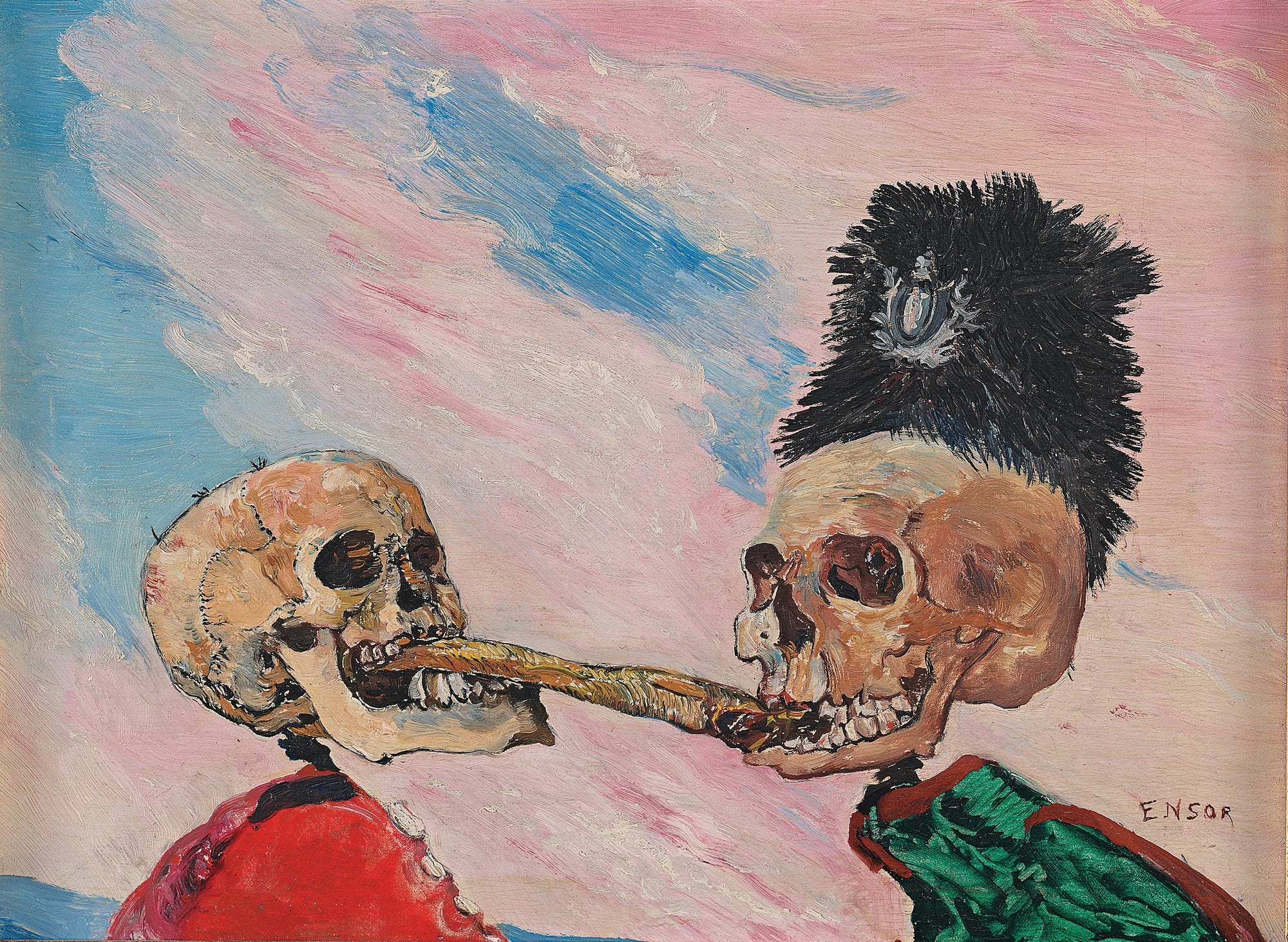
There is that moment when you find something gone bad at the back of the fridge. It’s rotten, covered in mildew, it’s ugly. Very. It’s where your body chooses to do something before the mind even knows about it. The repulsion comes first, then the realisation. At times, you are already turning away, or trying to, but then the stench of it chases you, the word spoiled idea arrives, late, like God’s promised Thy kingdom, but real, but better, but more interesting.
Have you ever thought about what it’d be like to be a slime, with a distributed mind, a fungal spore network, to grow another?
Because I do, all the time.
What would be the social and psychological implications? To wake up and live with those things. How would it be? How would you feel?
That’s philosophy, my friend.
I write toward that moment of lurch, of realisation, of whatever comes after the experience of the filth, the ugly, the bodily and bodily is most important here, for I have a special relationship with the body.
Body
Or, what can the body be?
The hypothetical.
We agreed that, in nature, disgust is a lowly feeling. Religion concurs. Catholics teach that the body is filthy, secondary. The immaterial soul is what matters. All those bodily tendrils, tentacles, tails, pleasure, or orgasms, they are all impure, they’re all filth. They are either sin or the tools of sin.
The rebellion of the body, or body horror, launches at that, at the scholastic tradition, at the mind-body duality. Because body horror reembraces the body as something that can be reimagined, changed, and transfigured. It lets us think deeply. It lets us feel strong emotions.
Through disgust.
Because let’s face it, it’s the root of it, the radiant core of it, that spits out emotion.
I first met disgust as horror in the films of David Cronenberg.
The Fly was a movie I saw when I was 7. It scared the hell out of me. And you shouldn’t watch it at that age, but my dad had funny views on upbringing. We were good to go, to watch horror and gore, but not sex. Typical for any reputable Catholic family. The base hypocrisy of it goes like this:
Filthy is okay, even preferred, the leprotic, the martyrs, but pleasure? Oh, please, God forbid. Let’s not have pleasure. Pleasure is when the body becomes a sin.
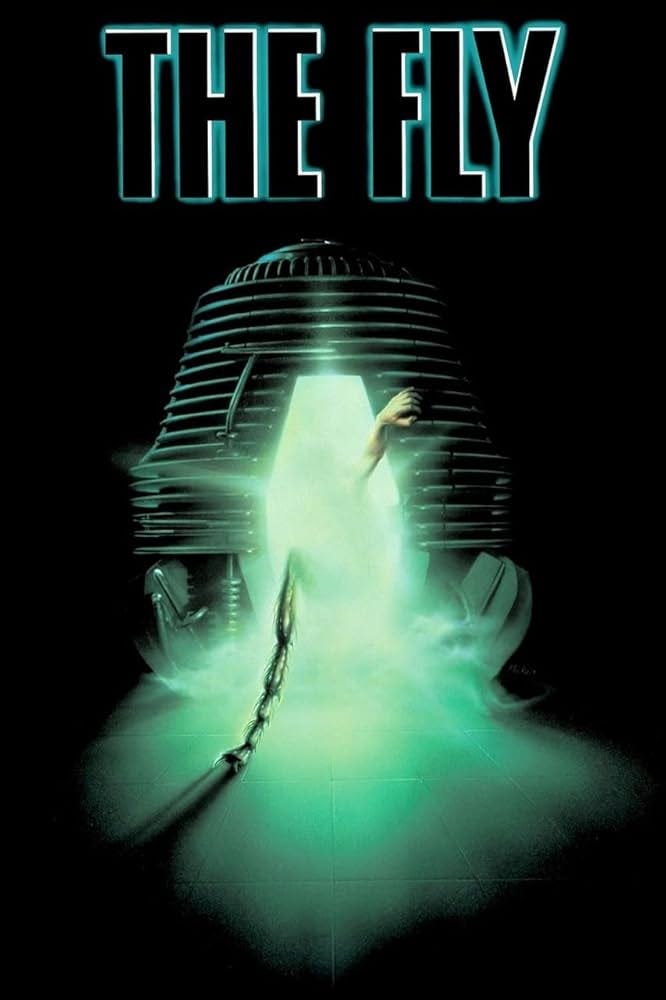
Back to The Fly. The main character uses his mutation to his own benefit. For that, he’s sinful, egotistic, or boastful, or so would the zealots say. Yeah, he is a monster. But it’s not that clear-cut if he’s evil. This can be reinterpreted either way.
Second, on Cronenberg. Cronenberg’s body horror is deeply metaphysical, and that pulled me in straight. It is about the mind and body proper, where one causally affects the other. They interact with each other. Yes, they change each other. Body horror is about that kind of change.
In The Brood, Cronenberg invents a faux therapy theory called psychoplasmics. Dr Raglan, the guru guy, teaches his patients to go all the way through their rage and other emotions. When the emotion surfaces, it does so materially, in the body. It is welts, causes lymphatic blisters, makes a woman give birth to her fury as a litter of dwarf children who beat her mother to death with kitchen mallets.
And Cronenberg refuses metaphor. The tumour isn’t like grief. It IS grief incarnate, with the body's blood supply. The borders blur. Psychosomatic illness is the psyche writing onto the soma, with no mid-layer. Cronenberg’s threat is endocrine. You secrete it.
Body horror is emotions manifested as body, and when I look at the roots of it, disgust used as art, evoking a strong emotional response, I look back to German expressionism.
Expression
Expressionism proper blasts off in Germany around 1905 (Die Brücke, Der Blaue Reiter), as a refusal of the whole realist (representationalism) trend.
If impressionists painted light penetrating the world, then the expressionists painted what the hell the world was doing to us. Inner life presses onto the outer surface until the eyeballs deform and spill out there, in the world. And they spill as acid colours, gouged lines, fucked up people, perspective bent like a nervous system under load.
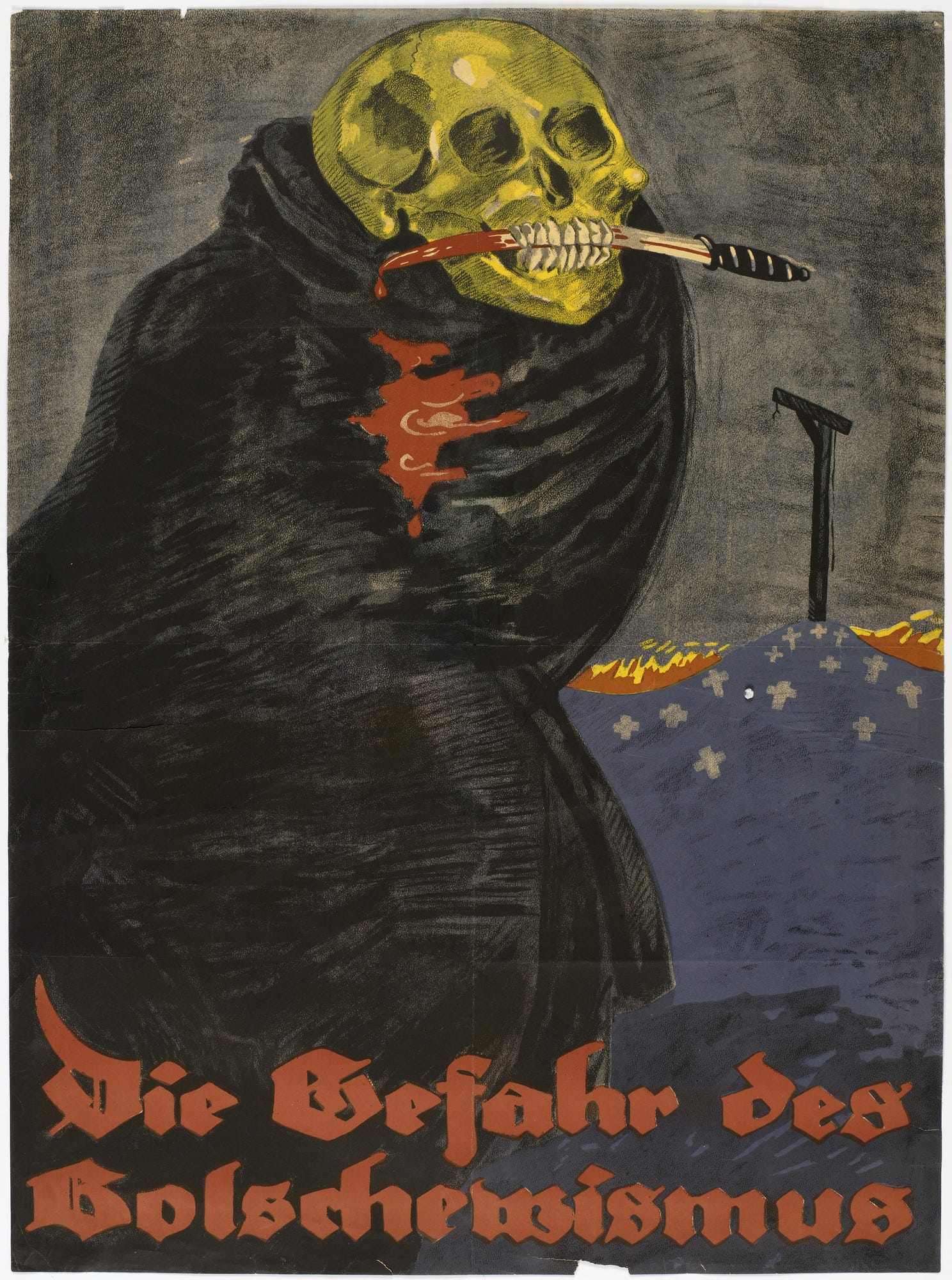
And it spread really fast into poetry (Benn, Trakl, Heym), then into theatre, and film (e.g. Caligari’s painted shadows). The ugliness wasn’t a byproduct, but the whole point.
Look at this poem by G. Benn, who was a doctor by trade. Little Aster poem from one of his collections:
Little Aster

A drowned beer-hauler was heaved onto the slab.
Someone had wedged a lavender aster
between his teeth.
As I reached through the chest
under the skin
with a long knife
to cut out the tongue and palate
I must have bumped the flower, for it slid
into the brain lying alongside.
I packed it into the chest cavity
with the sawdust
as we sewed up.
Drink your fill in that vase!
Rest in peace,
little aster!
It surprises many that Benn wrote this in 1912.
Then, new expressionism, neo-expressionism, and Neue Wilde had emerged, later in the century. The Berlin painters — Fetting, Salomé, Middendorf — had spent the early eighties painting emotion tearing through form. Heftige Malerei, they called it. Violent painting.
In Poland, where I’m from, we had our own way, Nowa Ekspresja and Luxus. Painters who worked under martial law had plenty of inspiration. Pawlak painted pigs. When canvas ran out, they painted on bedsheets.

In America, there was Basquiat:
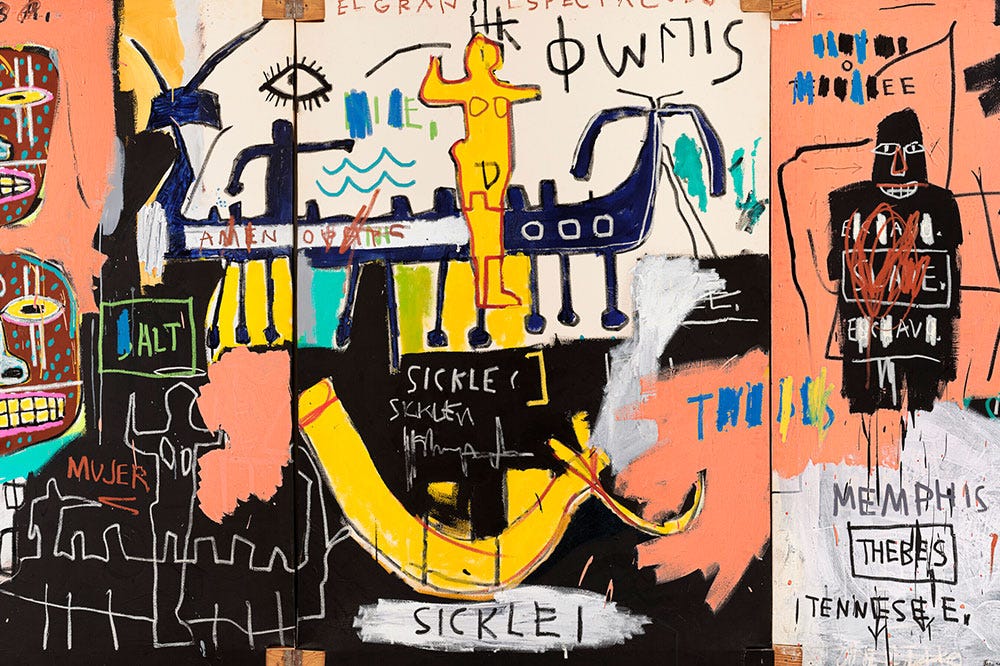
And many others.
Because of my early exposure to the filthiness of life (on that, some other day), expressionism drew me in. And realism made me sick (it still does). I wanted more. Reality was not enough.
My own paintings taught me things that prose later confirmed: oil paint is like fat. Sometimes animal fat. There’s no sprinkling it up. You are smearing lipids on a surface, and it’s a spiritual exercise. Every painting is a garbed body through which emotion screams.


Expressionism never pretends otherwise. It attacks everything with strong emotion. A lot of the modern horror is based on that.
I said before that disgust is often treated as a malfunction. Stuff we repress, a thing we medicate out. The eye aversion, the evolutionary reflex of a squeamish nervous system that hasn’t yet been civilised, or hasn’t undergone the peak of rational thought.
But, to me, DISGUST IS NEEDED, and required even, for growth. It opens up doors to all kinds of experiences I find myself elevated by.
We have it all exactly backwards in the world. Because disgust is the only emotion that cannot be talked out of itself and myself, my yapping mouth, my I.
The I
There’s I and Not-I in this world. What is I, and what isn’t I?
Non-I is where the body horror starts, when the distinction blurs. Not-I becomes I, unexpectedly, unwantedly. An extended I is the product. A mutation, or an alien object, a bizarre condition. It violates my I. This violation, this extension of I, is what is scary, at first. It operates through disgust first. It gives a constant, continual shock of it. The form of I is distorted, melted away, plunged in and dragged through hell.
This extension, be it a protruding antenna, an alien pregnancy, or some unknown limb, is an extra emotional charge added onto us. It’s like a grenade glued to my calves, a surplus burdened with explosion. And it explodes with emotion.
This is how my expressionism talk relates to the body horror talk, because with body horror, I gain another dimension: it goes beyond. I becomes a host of unheard emotional expression. It is both expressing and receiving it, and storing it. Like in Cronenberg’s films I mentioned earlier.
Disgust is at this sanctified border of the self. It sits there with more precision than any other feeling. Anything that violates the border is terrifying, not because it is alien but because it is the most familiar thing there is. A natural feeling. It’s like finding out about cancer.
The addition of the new gory limbs, a new strange condition, adds a metaphysical sensibility, giving us a new, unknown meaning. It expands us past the previous set borders. And the meaning is something we must reconstruct again. Sometimes from scratch. The whole appeal of body horror is there.
But the body is not all I find compelling about horror. There are things beyond the body that cause eerie feelings. Very scary things.
Surreal
The most frightening movie I’ve seen was made by David Lynch. And it wasn’t jump scares. No, not that. Let me explain. Lynch was a filmmaker who employed an anti-logical, anti-rational method to plot-driving, borrowing a lot from the surrealist movement.
When I watched Fire Walk With Me, it freaked me out. The moment towards the end, unexplained, involved a flickering red colour and a scene with almost no logical exposition. Because it lacked any logical explanation but generated this uncanny feeling-"Oh, something’s wrong"-it created an intense sense of unknowable dread in me. More powerful than any J-Horror or slasher ever could. More powerful because we cannot logically explain or find it. We are powerless.
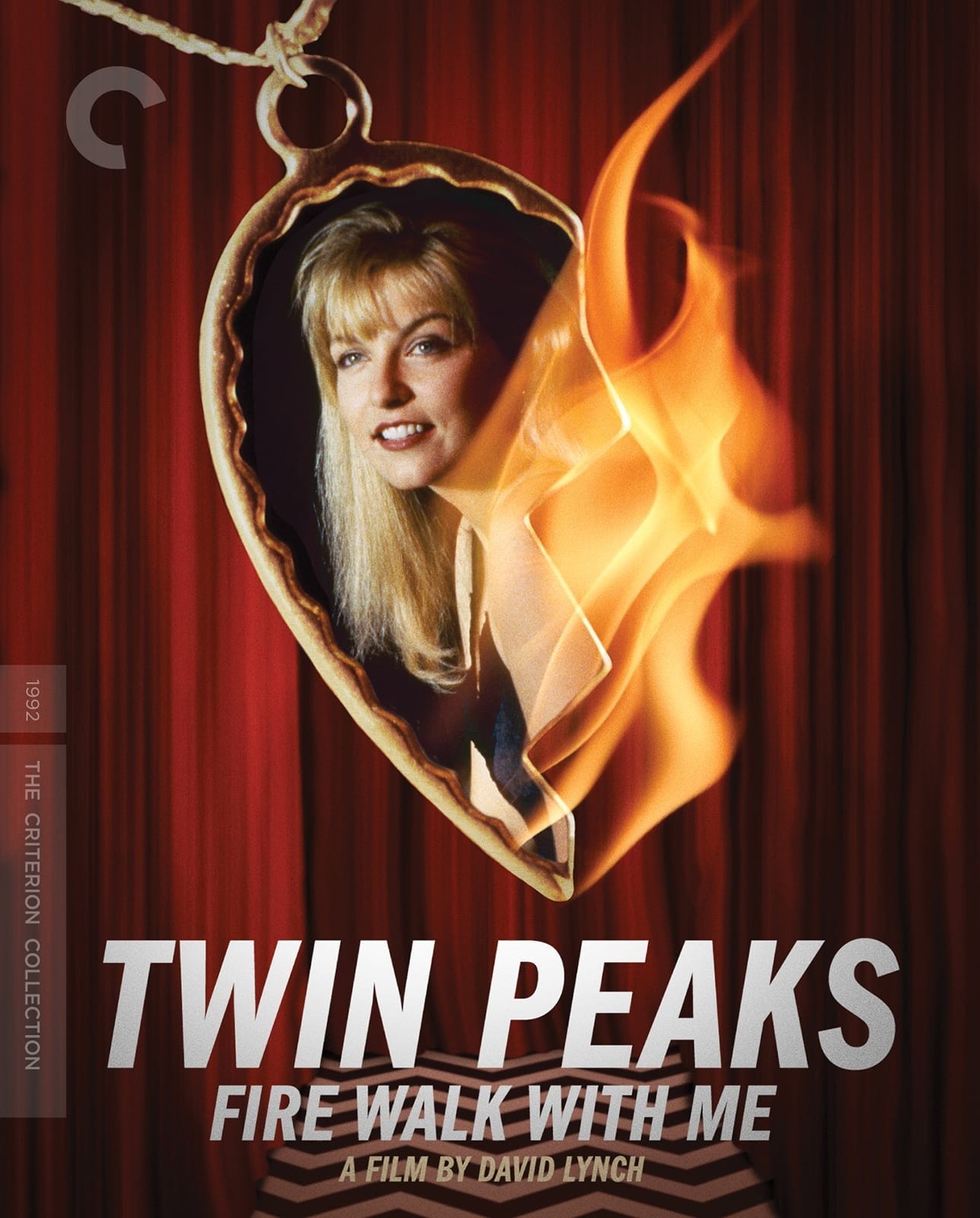
There are more examples in Lynch, like the man behind the diner in Mulholland Drive. Or the baby in Eraserhead, which disgusts because it has no category to sit in, calf fetus, prosthetic, infant, mistake, and Lynch never said or explained it. Or the severed ear in the grass that the camera enters. Nothing in these images tells you anything about it. And the not-saying, and never knowing, is the true horror.
It’s like:
The body signals contamination, but cannot locate the contaminant.
And it is unsettling as hell. Disgust that hasn’t yet found its object of disgust. Its source, you can never find it. A nausea in search of a referent.
(Which also explains my other obsession with flash and microfiction, because it’s the kind of art that tells more from outside of the prose itself. The art of skilful omission that makes the imagination work.)
So, unfoundable, semi-nonsensical, mysterious, and untold. This is where we are now, and this ties me to cosmic horror, another one of my motives.
Cosmic
It goes like this:
Once upon a time, there was a hidden, mysterious gulf that you didn’t know existed. But, oh, the horror, it very much knows about you!
So, it is horror at an unknown distance, horror as far as deep space astronomy.
Disgust at a far distance.
Things are “indescribable,” “unnameable.” This interests me for many reasons, most of them non-Lovecraftian. As a young student, I recall taking great interest in philosophy and things beyond comprehension (which plays into the same weird feeling of omission that chaperones Lynchian films).
In philosophy, Schopenhauer’s idea of Will is a blind craving that lies beyond the world we see. And it has fascinated me ever since. Ideas brutally objectify into existence as things through Will itself. A flower, a car, and even ourselves. The Will wants to know and understand itself, it’s akin to Lovecraft’s Azathoth, but more metaphysically plausible.
And here’s the funny twist. You will see parallels to the body change here.
In Schopenhauer, say, Intellect manifests itself as the brain. Like in Cronenberg’s Brood, grief can re-manifest itself as a body extension (psychoplasmics).
The world as Will, a blind hunger that gorges, where every creature is the meal of the other, and the whole universe is one endless act of digestion.
In that cosmos, you’re not some speck before the void. Being ignored would be mercy, but that doesn’t quite happen. No, not so fast. “They” won’t leave you alone. You are a nutrient. And bad news, you are already inside its body. The stars are not far away. They are, but the lining of the stomach.
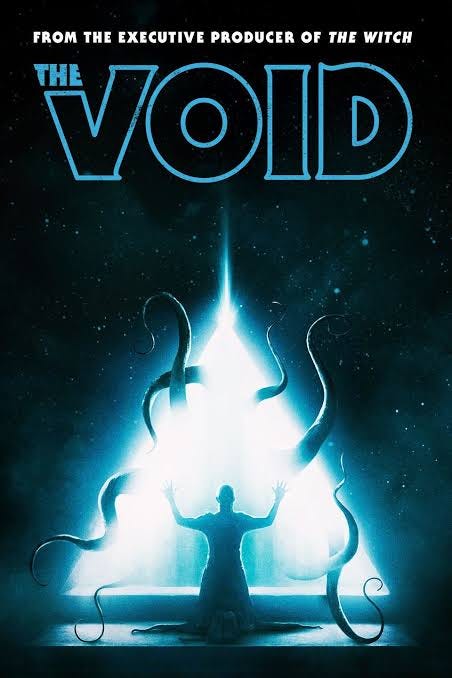
As for films, one of my favourite cosmic horror movies that represents similar tropes is The Void. Why favourite? It lives on the periphery of the body and the cosmic horror, so you get the whole package.
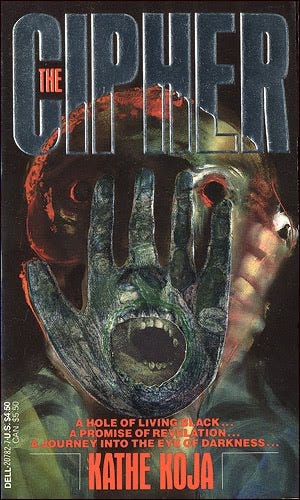
On the page, the purest specimen I know is Kathe Koja’s The Cipher (1991). It’s the definitive body/cosmic horror book. It goes like this: Two burnouts find a hole in the storage-room floor of a dead-end apartment block — the Funhole, black, wet, absolutely there — and whatever goes near it, comes back… well, different. The characters themselves are the pure embodiment of filth. They are degenerate and drink too much alcohol. They fail, and they have sex for benefits. They burst out in short-tempered tantrums. It is expressionism back again. The ugliness and emotional explosion. But I won’t spoil much. Koja mixes cosmic and body elements, but the real event is the prose. Koja is a wordsmith and writes in a comma-spliced, feverish, self-interrupting rush, sentences that blister and weep mid-clause. The form is the infestation.
But OK, the body, the I, the cosmic. What else is there if we've beaten it all down already?
There’s one more thing I alluded to: since not only does the body change its form, but writing can as well.
Form(less)
To me, just as the transfiguration and mutation of the body is key, the same counts for the text.
In 1929, Georges Bataille, our little transgressive philosopher writer, wrote in Documents that Formless is not a description but a job: a word whose task is to declassify, to bring things down in the world. The universe resembles nothing, he said — something like a spider or spit. That’s what body horror runs on. Not just the gross-out, but the declassification underneath.
By contrast, Modernist writers experimented with new forms: Joyce, Woolf, and Pound. Meaning was important throughout modernism to high-modernism of Finnegans Wake, where Joyce does what I call “Overmeaning”, creating new word inflexions, word plays and neologisms that convey much more than what they resemble at the time.
In Poland, we meet Witkacy, a playwright, painter, novelist, and owner of a one-man portrait firm. His canvases came annotated with the drugs he’d taken while painting them. Around 1919, he laid out the Theory of Pure Form: Art’s only legitimate job is to trigger the metaphysical feeling. The shudder at the strangeness of existence. The unity flashing through multiplicity. Not to tell a story. No focus on psychology or a message. It should hit you the way shrapnel, or a symphony, or an abstract painting does, with events, colours, screams and corpses arranged (or re-arranged). The content itself is secondary and even illegible. And that’s fine (better, even) so long as the whole delivers this beyond. You leave the theatre as if waking from a dream where the most ordinary objects glowed with weird-ass menace.
Does it sound familiar to what we said before?
Witkacy developed the Lynch “method” sixty years before him, purely on theoretical grounds. But he never got to see where this went. In September 1939, the Soviets crossed the border, and he took his own life, not wanting to live through another World War.
Forty years later, Burroughs and Gysin made the demolition of form systematic.
Paris, 1959, the Beat Hotel.
Gysin slicing through newspapers with a Stanley blade while mounting drawings, noticing the strips recombining into sentences nobody wrote. He passed it to Burroughs, and then you got the Nova trilogy. Fold-ins, tape-recorder experiments, all of which theorised it in The Third Mind (1978).
For Burroughs, language is a virus: an organism that colonised the human throat somewhere back in prehistory and has been dictating ever since.
So the cut-up is not a game. You interrupt the parasite’s transmission by doing that. Cut into the present and, he said, “the future leaks out.”
And the third mind itself is the best part: two guys generating a third intelligence that belongs to neither of them. An author produces an extension, a not-I, meeting your weird tapeworm.
Notice, the form experiment became body horror in the text.
Postmodernism further broke forms but traded rage for a cynical smirk. Grand narratives were declared dead by philosophers; everything was put in quotations, and pastiche was the style. The formal experiments in metafiction, collage, and recursion now prove that meaning is a construct. It was dead. It’s all form games, but the outcome is… bloodless. Irony is an industrial solvent for anybody looking for Truth. Nothing is serious, everything is jest.
Pendulum swings
So now, we’re finally back in the 21st century. Huh, what a ride.
I mean, what else can we come up with?
Modernism swings toward form-as-meaning, or “Overmeaning”, breaking the sentence to fit more Truth. Then the postmoderns bite back: they break the sentence and its meaning to show there was never any truth in it.
Picture the pendulum.
Imagine it swinging…
Imagine…
Imagine…
Still, imagine…
…And BAM, we’re in metamodernism now.
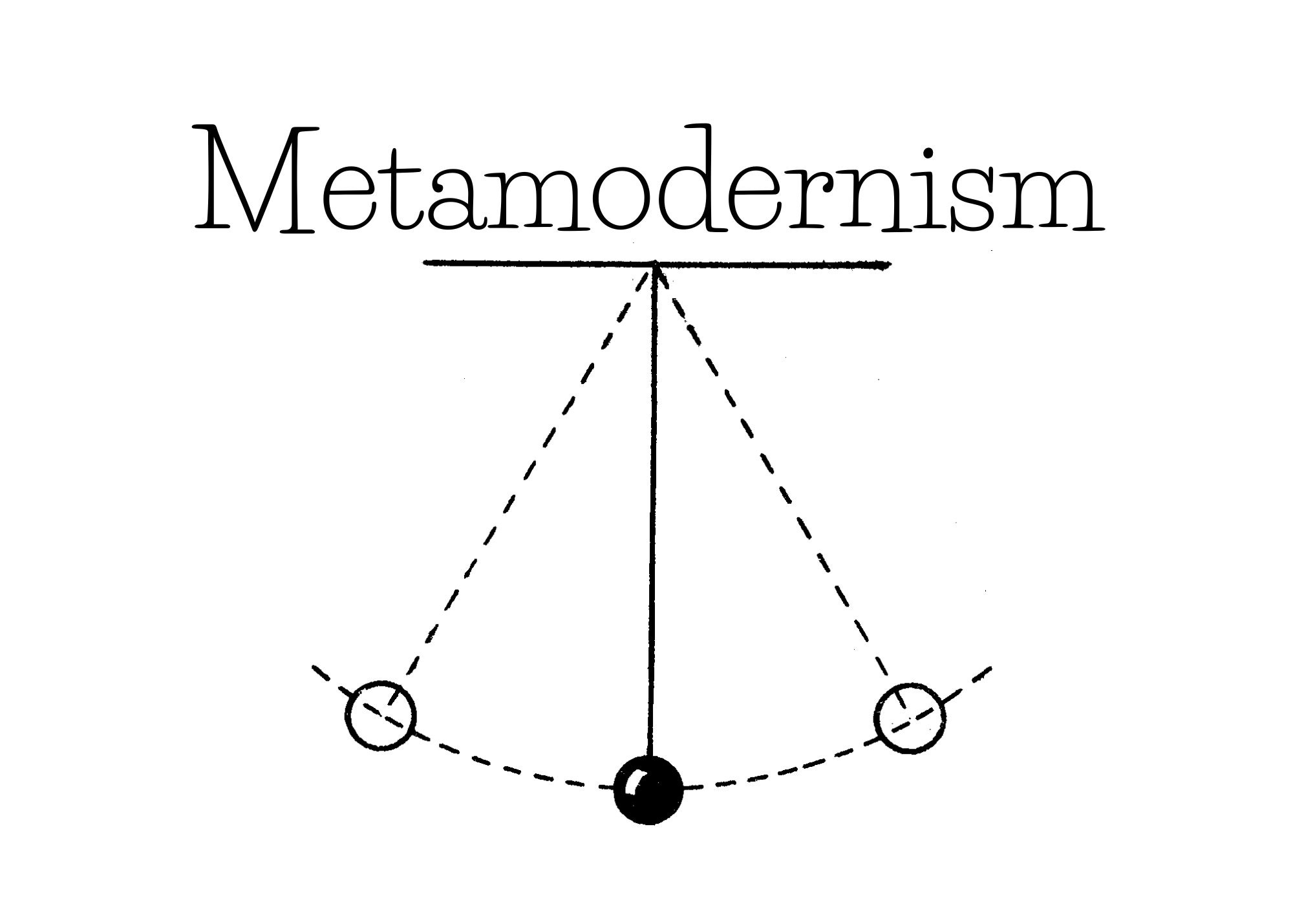
Metamodernism is an oscillator. It doesn’t want to stop swinging between the two, between sincerity and irony. They pass through each other twice a second.
And here’s where I drag it back to my fridge.
Disgust is the ultimate metamodern emotion all along. You can’t be ironic about retching in pain and dying in agony. AT LEAST NOT IN THE MOMENT OF IT. The “lurch” arrives before your interpretation, your irony, or the power to swallow it. Disgust survives deconstruction and can still build some meaning in the moment after.
The pendulum swings through your actual fucking body.
The Method
It’s good to build the sentence that turns your stomach inside out, then your head, your precious head!
And that head, dear, won’t tell you what it means. Not now.
The images, even the strong ones, are there, but the meaning collapses. You will likely be confused by the form, by the event, and the source of the confusion is missing. The unknowability, or the uncanny cosmic dread, will take its place.
At some point, the meaning, from formlessness, from confusion, will start reintegrating again, only to shatter again.
This is, more or less, the shock effect and the cycle, the swing.
Let’s say, if we formalised it in something like that:
→ Disgust → collapse of meaning → dread → reintegration → acquisition of meaning → Disgust →
Then, if we install it as a plot:
→ Grief grows a devouring limb → What does it mean!? I’m lost! → Oh, I am scared! → Wait, my body part has a function! → Oh, it’s beautiful! So powerful! → Oh NO! It’s eating my boy, my booy! →
See, the pendulum runs through all of it: meaning collapsing and, in the collapse, getting caught in the act of being remade. Sense and nonsense, form, formlessness, form again, swinging into each other on the page, in real time, the way not-I becomes I. It doesn’t have to be all at once every time. No. Sometimes you want to write a multigenre psychological thriller, sometimes something batshit.
But the key thing is: Transfiguration is a method. It produces the “new organ” that we try to get to grips with (incorporate its meaning).
Disgust is how it’s working. The only readerly response that can’t be faked, ironised, or talked down.
So Why Do I Write?
I write to assist the “fridge moment” and expose a new philosophical and metaphysical lens through it. Reintegration from absolute nothing. From the decay of things.
That’s the position I write from. Not the modernist’s faith that the broken form hides a higher sense. Not the postmodernist’s relief that there’s no sense to hide. No nihilism.
Anyway, the fridge is open. Actually, mine is, at this moment, and I’m quite hungry. The smell has reached my precipice.
I write so the realisation never arrives too quickly, but in this case, I guess my fridge can defrost? I should close it again, and then open it… Can’t I?
And you keep leaning in, listening to me anyway. Joke’s on you. No, no jokes, that’s the joke itself.
Third Eye Horror
© Mac Sitko, 2026
All rights reserved.
I like when people can articulate their impulse to write so clearly, especially when they’re able to contextualize it like this. Disgust is a powerful emotion that can drive exploration and I related to some of this. Thanks for sharing!
The cycle you map out lands hardest at the reintegration point.The cycle you map out lands hardest at the reintegration point. That's where horror does what nothing else can: it gives you back a meaning you didn't have before, built out of the wreckage of the one you walked in with. Disgust is the only emotion that can do that without lying about what it costs.